
Call us today +64 9 479 8844 


Call us today +64 9 479 8844
on Wednesday, December 2nd, 2015
September proved to be an exceptionally busy month for the RPM crew, with not one, but three large press tools underway in the work shop.
All three tools were requested with minimal lead times, which meant all hands on deck. Everyone has an essential role to play in the successful supply of quality “A grade” tooling to our clients.
One tool in particular was very special, being for a first time overseas client, who have taken advantage of the benefits seen in the current exchange rates. It was our opportunity to make a good first impression and demonstrate the length and breadth of our skills at RPM.
The client had requested a 7 station progression press tool that would form flashing for solar roof tiles.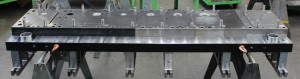
The stages commenced with a trim and hole pierce function, to help guide the form through the rest of the tool process. The next five stages gradually pre-formed the required profile more each time until the last stage where the final form was created and finished. This gradual forming process ensured that the metal sheet stock travelling through the tool did not rip or split as it would have done with a sharper or shorter forming process.
The press tool was designed to be used with Aluminium stock. Aluminium was chosen for its specific properties; in particular, good resistance to weathering, even in coastal areas. Aluminium reacts with the airs oxygen, and a thin passivation layer of aluminium oxide forms on the surface. This layer protects the metal from further oxidation and is very strong.
In choosing an Aluminium stock to produce components from, given the Aluminium surface strength; the components in the press tool will be subjected to excessive wear. The aluminium material is difficult to form and causes heavy wearing of the components within the tool.
This has been taken in to account when building the press tool and the customers own exacting standards have been followed to ensure that the tool will last as long as possible before requiring service and replacement components. This included heat treatments to through harden and nitride punches, dies and other blocks in the tool accordingly.
Much of the componentry incorporated in to the press tooling designs is only available off shore and therefore had to be sourced early on in the process for supply in time. This includes procuring products and items and building relationships with new and existing suppliers globally.
The press tool has 370 different globally sourced components, of which 24 are heavy duty gas springs, 48 are maximum deflection wire springs, 40 are punches and the balance are pins, plugs, guides and stock lifters. There were 306 cap screws. Every one of the other 192 single components was machined and finished in house at RPM. The largest of these being 2238 X 680 X 80 mm of steel and the smallest being diameter 20 mm x 11 mm long levelling pads, of which there were 28 pieces to manufacture.
The top shoe weight of the tool is 3113 lbs and the total weight of the tool is 6908 lbs. The tool is designed to press and form stock 0.032 inches thick and 14.125 inches wide. Each progression stage is 9.39 inches. This is the distance that each pressed panel travels between the seven stations before emerging from the process as a completed part.
Tool trial is always run on completion of the tool build, at which point, toolmakers, designers and the like are able to assess the success of the trial and what changes, if any, are required to be made to ensure that the tool runs optimally. It is essentially important that the tool works perfectly before shipping. Especially in the event of a new client, where we would hope to give them the best possible result in order to set a high standard and good reputation into place.
After a very successful trial run, the finishing touches were applied, before the tool was wrapped and crated for air freighting to the customer.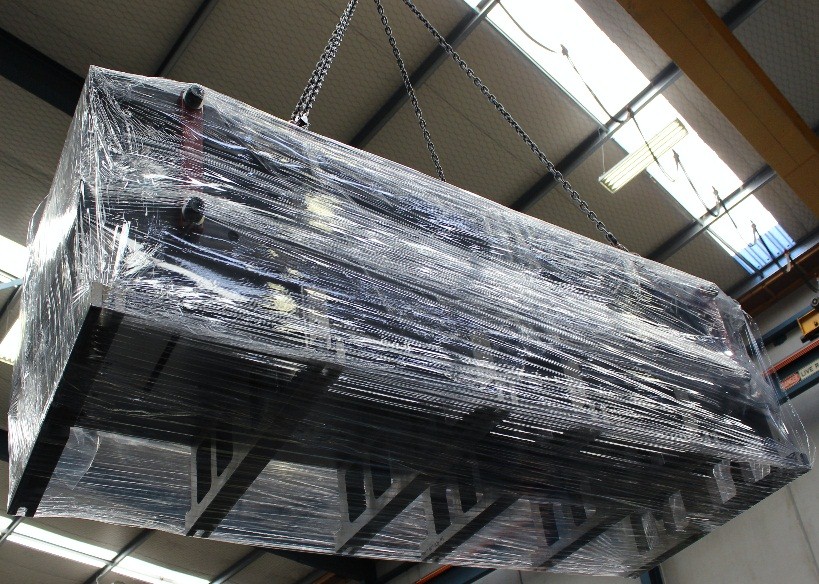
RPM always offer a full service and after service with their tool design and manufacture and as such, it was our preference that Company Director and Qualified Engineer, Mark Vincent meet the tool at the customer’s premises overseas. Mark was on hand to ensure the smooth and seamless installation of the tool and to supervise the tool trial.
Once Mark was happy with the installation and had the customer’s seal of approval, he was able to return back to New Zealand to share customer feedback and then focus on the next project.